Monday, January 7, 2019

Spring Semester- Week 1- January 10, 2019 Parts of a Chemical Reaction

This week we will be reviewing a few of the concepts we covered last semester in order to build up to this week's unit covering balancing chemical equations. Therefore, I thought it would be best to provide some preliminary notes and review material for students to study prior to class this week.


In the above video, I cover how to differentiate between elements, the parts of a chemical reaction, and how to count atoms. Additionally, the link to a worksheet on counting atoms that we did in class, but will be helpful when we balance equations.

Counting Atoms

Lastly, below are the notes for this week that need to be included in student's interactive notebook. The first two pages of notes are for Parts of a Chemical Reaction. The last page of notes covers Balancing Chemical Equations.

Chemical Reactions Notes page 1


Chemical Reaction Notes page 2


Update:
We had an awesome class last week! We started the class with a video that introduced The Parts of A Chemical Reaction (see below):


Then we used gum drops to build molecules so that we could have a visual of how basic chemical compounds are structured. This also helped us as we reviewed counting atoms.

Next, we went over the parts of a chemical equation and how to read a chemical equation. We used the graphic organizer page in our notebooks shown below to cover the states of matter, reactants, products, subscripts and coefficients.

Here is the link to additional copies of the graphic organizer for those who missed class or need an extra copy.

Monday, November 19, 2018

November 29, 2018 - End of Semester

It's time to celebrate! We've reached the end of the first semester of Middle School Physical Science! We've covered so much material this semester! It is my hope that this class has been fun and interesting, but most of all I hope students have become comfortable and been exposed to many of the concepts they will see again in High School Chemistry!

Below is a video I have recorded where I discuss the Interactive Notebook for this class and how it can be used to evaluate what has been covered during the first semester and how to assign a grade for this class, should parents desire a letter grade.


Additionally, linked below is a rubric that students can use to evaluate their interactive notebook (a hard copy was given to students in class) and parents can use as a guide to assign a letter grade.

Interactive Notebook Rubric

Next semester, we still have a few more topics in chemistry that we'll cover before continuing on to Physics. Those topics will be:

  • Parts of a Chemical Reaction
  • Balancing Equations
  • Acids and Bases
Enjoy the holidays and see everyone next semester!

Monday, November 5, 2018

Week 14 - November 1, 2018 Periodic Table Practice

So, last week, I had to cancel classes because my dog was injured at the Doggy Day Care. I took him to the vet during the only time I had available (class time--boo!), but I'm glad I did because he had to get stitches on his lip and along his gum line! His little nose has discoloration from his injuries, but he his recovering nicely.

This week in class, we became more familiar with the periodic table by playing Periodic Table Battleship and by doing a Periodic Table Scavenger Hunt. The kids REALLY got into Periodic Table Battleship!
 

Here is a link to Periodic Table Scavenger Hunt worksheets that we did after we played Periodic Table Battleship. We also colored a periodic table graphic organizer in preparation for next week's discussion on atomic bonding. 


Completed Periodic Table Graphic Organizer

Here is the link for those who may have been absent.Blank Periodic Table Graphic Organizer   

Next week, we will discuss Atomic Bonding. Below is a short video for students to watch that discusses the basics of ionic and covalent bonding.


Additionally, students can get a head start on the notes for the next lesson which I will be referring to heavily.

Notes page 1

Notes page 2
Looking forward to next week!

Monday, October 22, 2018

Week 12- October 18, 2018 The Periodic Table

This week we learned all about the Periodic Table. We watched an excellent video from Crash Course that discussed Dmitri Mendeleev and how he developed the periodic table. A link to the video is provided below:


Once we watched the introductory video, it was time for us as a class to organize candy periodically. This took a little time, but once we finished it was much easier to understand the genius in Mendeleev's approach.


Below are the two pages of notes for The Periodic Table.

The Periodic Table Notes page 1

The Periodic Table Notes page 2


The next activity involved us learning about the various groups/families on the periodic table and color coding tables to glue into our interactive notebooks. 


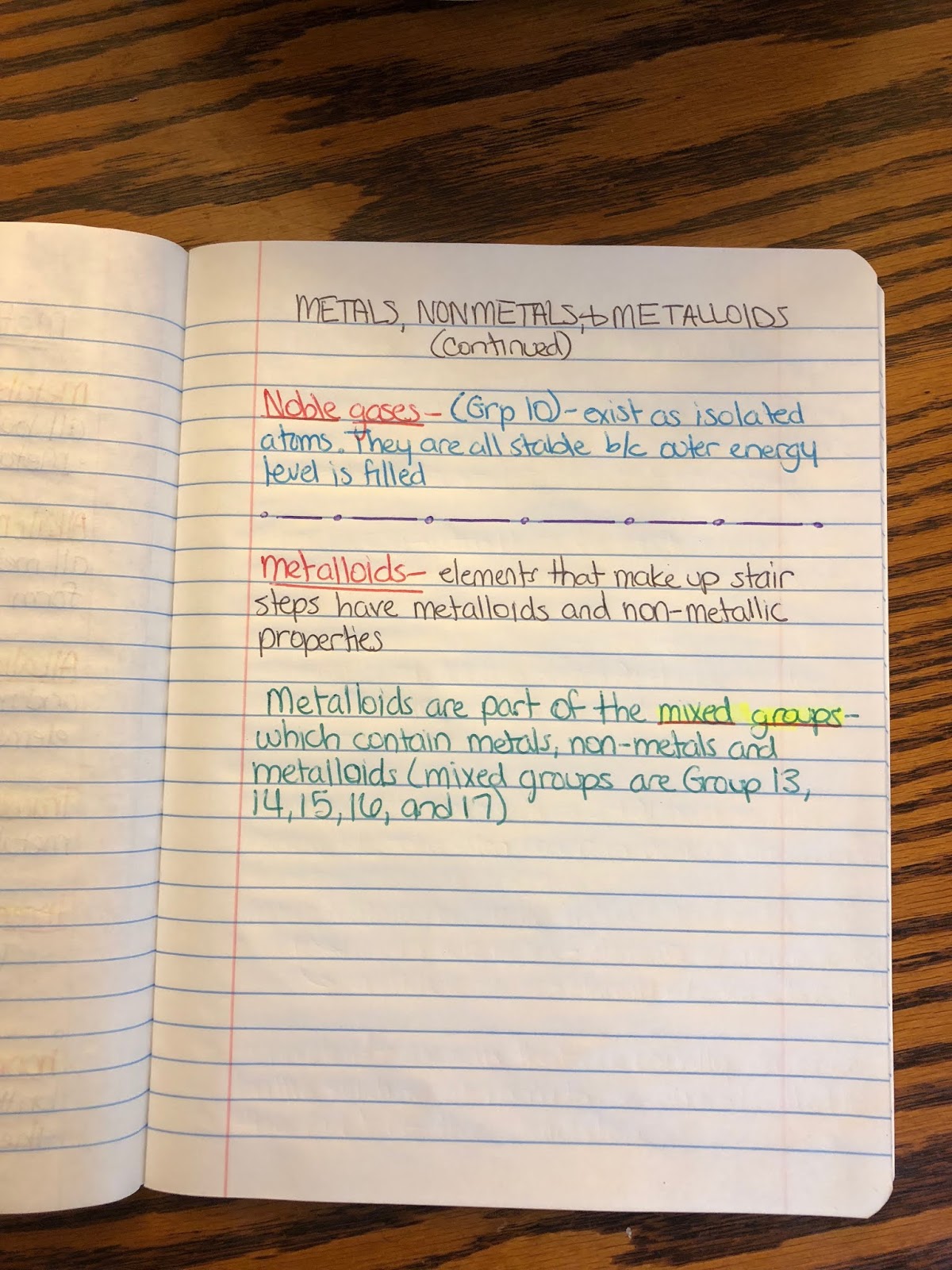
Our next set of notes covers what we discussed in class, the properties associated with each of the groups on the Periodic Table. See notes below:
Metals, Nonmetals, and Metalloids Notes pg. 1
Metals, Nonmetals, Metalloids Notes page 2
Unfortunately, we ran out of time to play Periodic Table Battleship, but we will play this and explore elements further this coming week before we move on to writing chemical formulas and chemical reactions.


Monday, October 15, 2018

Week 11 October 11, 2018 Isotopes and Ions

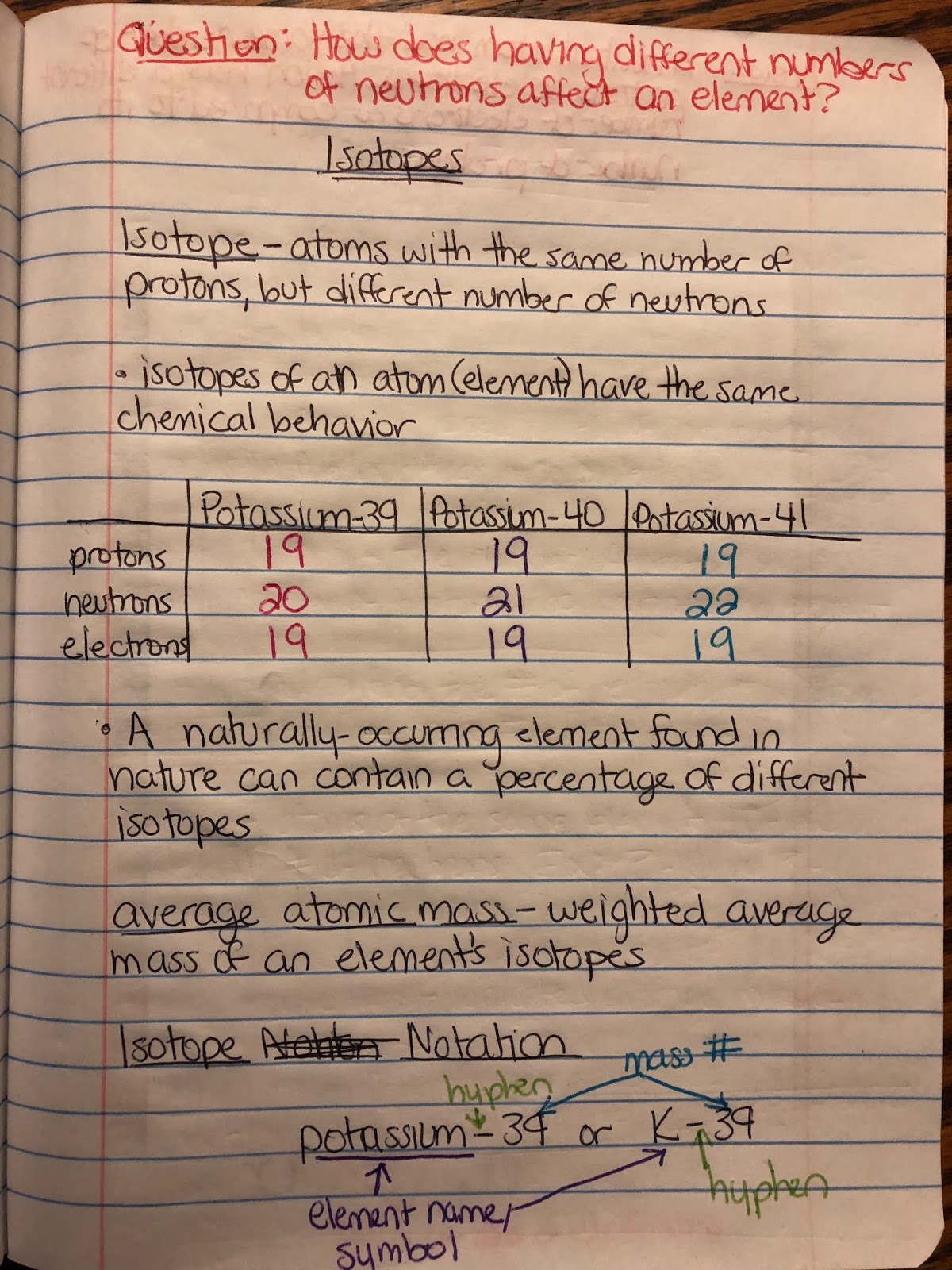
This week we added to our understanding of Atomic Theory. Last week, we began our discussions with a review of what a neutral atom is and how we can use a Bohr model to design various elements we find on the periodic table. We watched a short video on isotopes as well (see below) and discussed how we differentiate between various isotopes of an element. Using the Bohr model, we determined that isotopes vary based upon differences in the number of neutrons they have. Thus, different isotopes have different mass numbers. We distinguish between isotopes by mass number.


Students were given a worksheet that also served as their graphic organizer. They were able to work independently. They colored-coded the subatomic particles of various isotopes and practiced isotopic notation as well as determining the mass number and atomic number of the isotopes. Below is a copy of the worksheet.

Isotopes Worksheet/Graphic Organizer

Below are the notes on isotopes.


Next, we reviewed a neutral atom using our Bohr model of carbon as an example and discussed defined ions--more specifically, anions and cations. We also discussed the significance of valence electrons--the outermost shell electrons that are gained or lost. Below are the notes for ions.


Students worked on a second worksheet that gave them practice determining the number of electrons, protons, and neutrons were in elements. I was given the opportunity to work with students individually to help them fill in gaps in their understanding and clarify the concepts taught.
The key for the worksheet is shown below. They were asked to glue the worksheet in their notebooks as a graphic organizer for Ions.


Next week, we will be taking a closer look at the periodic table.


Sunday, October 7, 2018

Week 10 - October 4, 2018 History of the Atomic Theory and the Atomic Model

This week we started Unit 3 Atomic Theory by covering the history of how our current understanding of the atom developed. At the end of last week's blog, a Crash Course video quickly covers how the understanding of the composition of atoms went from the "atomos" idea all the way to our current electron cloud model. The History of Atomic Theory  video is shown below for those who didn't get a chance to watch it.


We cut out an accordion foldable and students were given directions on how to make a timeline to be added to their interactive notebooks. The information they need to make the timeline is linked below along with the graphic organizer/classroom activity we worked on in class, but students are to finish at home.
Atomic Theory Timeline and Bohr Model Worksheet

Students were given some notes to take during class because those notes would help them to construct Bohr models. The full set of notes are shown below:


We used poster board and Skittles to practice constructing various elements after determining the number of electrons, protons, and neutrons in a given element. Too bad I forgot to take pictures! Anyhoo, this exercise seemed to really help the kids to solidify their understanding of how atomic number relates to proton and electron number in a neutral atom as well how mass number relates to calculating neutron number.

Since I want to teach this in chunks, I want to leave students free to complete the worksheet we did in class and become comfortable with calculating protons, neutrons, and electrons in a neutral atom. Next week, we will continue this lesson and learn how to calculate the number of protons, electrons, and neutrons for an ion and discuss isotopes. From there we will move on to taking a closer look at the periodic table.


Monday, October 1, 2018

Week 9 September 27, 2018 States of Matter and Units 1 and 2 Review

This week we opened our lesson on States of Matter with root beer floats! What a tasty way to demonstrate the three phases of matter: solid, liquid, and gas! While students dug into their root beer floats, they watched two videos covering an introduction to the three states of matter and the fourth state of matter-the plasma state. Those two videos are linked below:


Next, it was time to cut out our graphic organizers for states of matter and changes in the states of matter linked below:


Here are pictures of how the graphic organizers should look in our interactive notebook:

States of Matter Graphic Organizer

Changes in States of Matter Graphic Organizer
Once we glued in our graphic organizers, we discussed the arrangement and behavior of particles in the three states of matter, the relationship between temperature and energy of the particles, and the endothermic and exothermic energy changes that occur as the states of matter change. Below are pictures of the notes for states of matter along with the answer that goes above the graphic organizer for states of matter.
Answer that goes above states of matter graphic org.

Notes on States of Matter

Additionally, below is the answer for Changes in States of Matter and the notes for Changes in States of Matter.
Answer for Changes in States of Matter Graphic Organizer

Notes for Changes in States of Matter


Finally, we ended class with a review of Unit 1 and Unit 2. Students were grouped into teams of 2 and given a mini-dry erase board and Expo marker. The questions were on the powerpoint and they had 30 seconds or so write the correct answer on their boards and then hold their answer up once the time was expired. Two teams tied for first place. I hope this game emphasized to the students the need to read over and study their notes at home, not just write them down to say they are completed. The game questions and answers are linked below for them to review further with their notes.
Unit 1 and Unit 2 Review Questions and Answers

In this upcoming week we will be starting Unit 3 Atoms and the Periodic Table.  I strongly encourage students to watch this Crash Course Video covering the History of Atomic Theory before they come to class so that they will be prepared for a review discussion and graphic organizer.